Mastery learning is a study approach where you don't move on to a new topic until you can show you've mastered the current one, usually by scoring around 80 to 90 percent on a short check. For students, that means notes are only the starting point. You turn them into questions, test yourself, fix what you miss, and check again until the topic is solid. Then you keep it solid with spaced review.
What Is Mastery Learning?
Educational psychologist Benjamin Bloom developed mastery learning in the late 1960s. In a typical class, everyone moves on at the same time whether they understood the last unit or not, so gaps pile up. In mastery learning, each unit ends with a short "formative" check. Students who pass move on. Students who don't get corrective work and another check. Reviews of the research, including a 1990 meta-analysis by Chen-Lin Kulik and colleagues, found mastery learning programs generally improved student achievement.
You can apply the same idea on your own, even if your class moves at a fixed pace.
Why Notes Alone Don't Get You to Mastery
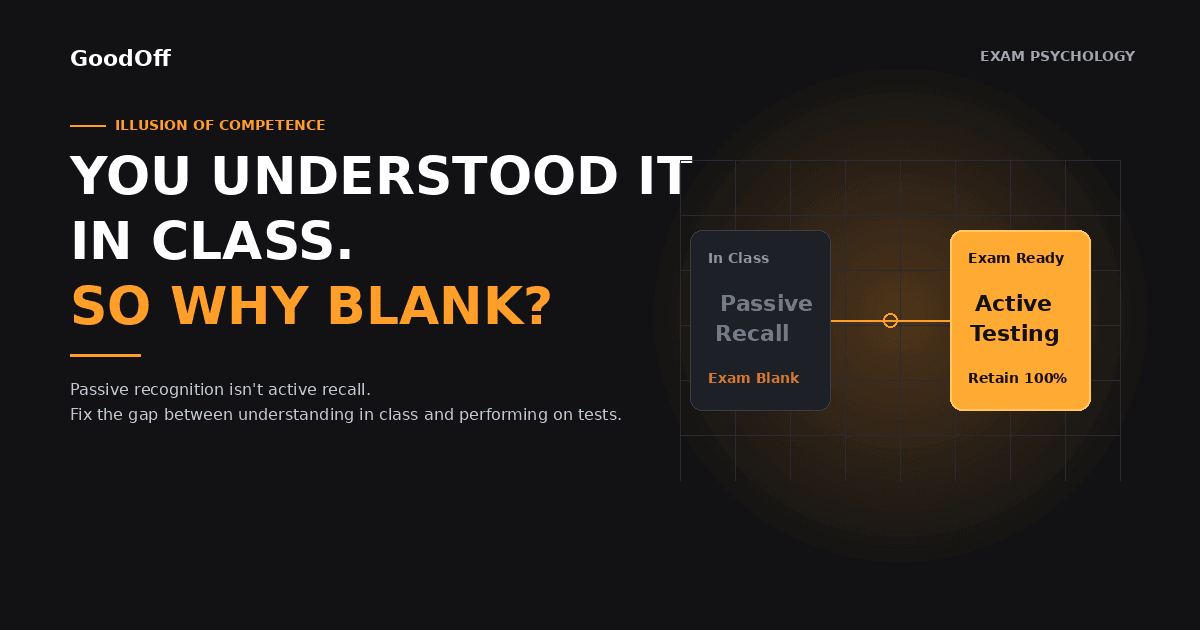
Notes collect information. They don't show you whether you can use it. Reading them back feels productive because the material looks familiar, but familiarity isn't the same as being able to answer a question cold. Without a check, you can't tell "I've seen this" from "I know this."
The Notes-to-Mastery Workflow
- Capture. Take notes in class or from the reading as usual.
- Convert. Within a day, turn each key point into a question. "The causes of World War I" becomes "What were the four main long-term causes of World War I?"
- Check. Close your notes and answer every question. Score yourself honestly.
- Correct. For each miss, go back to the source, re-learn it, and rewrite the question if it was unclear.
- Re-check. Quiz yourself again on the misses, and on a mix of the rest.
- Maintain. Once you hit your threshold, move the questions into a spaced repetition deck so mastery lasts past the exam.
Set Your Mastery Threshold
| Situation | Suggested threshold |
|---|---|
| Foundation topics later units build on | 90% or more |
| Regular course content | About 80% |
| Nice-to-know details | Lower, review lightly |
Foundations deserve the highest bar. In math, chemistry or languages, a weak early unit makes every later one harder.
Example: One Week in a History Class
- Monday: lecture notes on the causes of World War I. That evening, turn them into 15 questions.
- Tuesday: first check, 9 of 15 correct (60%). Re-learn the 6 misses from the textbook.
- Wednesday: re-check the 6 misses plus 4 random others. 9 of 10 correct. Threshold met, move on.
- Next week and after: the questions come back in short spaced reviews while you work on new units.
Making It Fit a Busy Schedule
- Keep checks short: 10 to 15 questions per topic.
- Do the conversion step the same day as the lecture, while it's fresh.
- Use the blurting method as a fast check when you don't have questions ready.
- If you're behind, apply mastery to foundation topics first.
How GoodOff Helps
GoodOff speeds up the convert and check steps: upload your notes, PDFs or slides and it creates editable flashcards and a quiz. Quizzes explain each answer for the correct step, analytics show your accuracy by deck so you can see when you've hit your threshold, and FSRS scheduling handles the maintain step.
Frequently Asked Questions
What is mastery learning in simple terms?
Learn a topic, check yourself, fix what you missed and check again, and only move on once you score high enough.
What score counts as mastery?
Many mastery programs use around 80 to 90 percent. Use the higher end for foundation topics.
Can I use mastery learning if my class moves fast?
Yes. Apply it to your own review, and focus on the topics later units depend on.
How is mastery learning different from cramming?
Cramming aims to get through one test. Mastery learning checks real understanding topic by topic and then keeps it with spaced review.
Try It on One Topic
Take today's notes, turn them into ten questions and answer them tomorrow with your notes closed. If you score under 80 percent, re-learn the misses and check again before moving on.