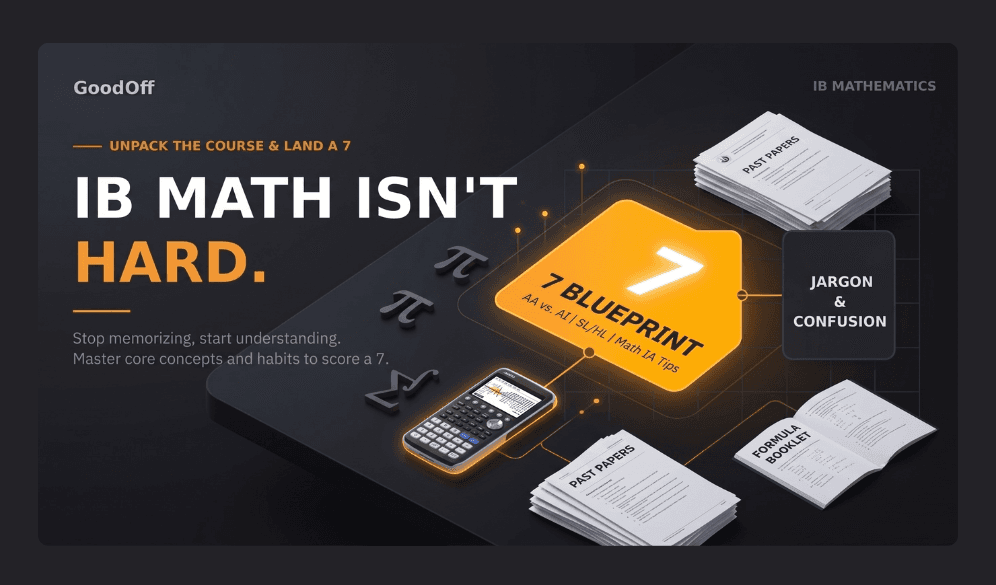
If you’re doing the IB Diploma, you already know that few subjects trigger as much debate or late night study panic as IB Mathematics.
Between deciding between Analysis & Approaches (AA) and Applications & Interpretation (AI), choosing your level, and tackling the Internal Assessment (IA), it can feel overwhelming. But once you understand how the system works and what examiners are actually looking for, IB Math becomes far more manageable.
Here is a straightforward guide to choosing the right track and setting yourself up for a top score.
1. AA vs. AI: Which Track Should You Choose?
The IB Math curriculum splits into two main pathways: Analysis and Approaches (AA) and Applications and Interpretation (AI). Both cover algebra, functions, geometry, statistics, and calculus, but their focus and daily style are completely different.
Feature Analysis & Approaches (AA)Applications & Interpretation (AI)Core Focus Pure math, proofs, algebraic manipulation, and abstract calculus: Applied math, real-world data, statistics, and mathematical modelling. Calculator Use: Includes a non-calculator exam paper; emphasizes manual algebra. Graphic Display Calculator (GDC) allowed on all papers. Best For: Engineering, Physics, Computer Science, Pure Math, and Economics at top universities.Business, Social Sciences, Medicine, Psychology, Architecture, and Design.
If you enjoy solving complex equations on paper and understanding why a formula works, AA is usually the better fit. If you prefer applying math to real-world scenarios using technology, AI is designed for you.

2. Standard Level (SL) vs. Higher Level (HL)
Once you pick your pathway, you need to decide between Standard Level (150 teaching hours) and Higher Level (240 teaching hours).
Standard Level (SL): Covers core concepts with moderate depth. Perfect if you need a strong math foundation but aren't targeting a math-heavy degree.
Higher Level (HL): Dives deep into vectors, complex numbers, differential equations, and advanced calculus. HL exams also include Paper 3, which presents extended problem-solving scenarios that test how well you adapt under pressure.
Pro Tip for University Prep: STEM degrees almost always require AA HL. Business and Economics programs vary some accept AA SL or AI HL, while others explicitly demand AA. Always double-check entry requirements for your target universities before committing.
3. How to Ace Your Internal Assessment (IA)
The Math IA is an individual exploration worth 20% of your total grade. It’s marked across five criteria: Presentation, Mathematical Communication, Personal Engagement, Reflection, and Use of Mathematics.
Here’s how to make yours stand out:
Pick something you actually care about: Personal engagement accounts for 4 points. Connecting math to a hobby like analyzing sports statistics, the geometry of architecture, or the calculus behind audio production makes writing the paper much more natural.
Prioritize clarity over extreme complexity: You don't need to invent new formulas. Doing SL or HL math accurately with clear explanations will score much higher than attempting university-level concepts filled with calculation errors.
Reflect as you go: Don't save all your thoughts for the conclusion. Evaluate your assumptions, highlight data limitations, and suggest tweaks to your model throughout the essay.

4. Four Practical Habits for Scoring a 7
Master Your Graphic Calculator
Whether you’re in AA or AI, speed on your Graphic Display Calculator (GDC) saves valuable minutes during exams. Make sure you can graph functions, find intersections, solve polynomial equations, and compute matrices without guessing where the settings are. (See the image above for a typical student GDC setup.)
Ditch Passive Reading for Active Problem Solving
Reading through textbook solutions creates a false sense of security. Work through problems actively without looking at the answer key until you've given it a genuine attempt.
Practice with Official Past Papers
IB questions use specific command terms (like "Hence, or otherwise..." or "Show that..."). Working through official past papers under timed conditions builds familiarity with exam pacing and mark scheme patterns.
Annotate Your Formula Booklet
Your formula booklet is open to you during exams, so make sure you know it inside out. During study sessions, write notes next to key formulas explaining when to use them, what each variable stands for, and common mistakes to avoid. (Review how a student actively references the booklet in the image above.)
Wrapping Up
Scoring well in IB Math isn't about being a natural math genius it comes down to picking the right pathway, staying consistent with past paper practice, and approaching your IA methodically.