Discover the ultimate active recall and spaced repetition hacks for competitive exams. Explore the Leitner system, structural chunking, and how to use advanced learning loops to protect your focus and double memory retention.
Let’s be entirely blunt: the standard method of preparing for high-stakes exams sitting under dim lights highlighting a 300-page textbook—is an absolute waste of your cognitive energy.
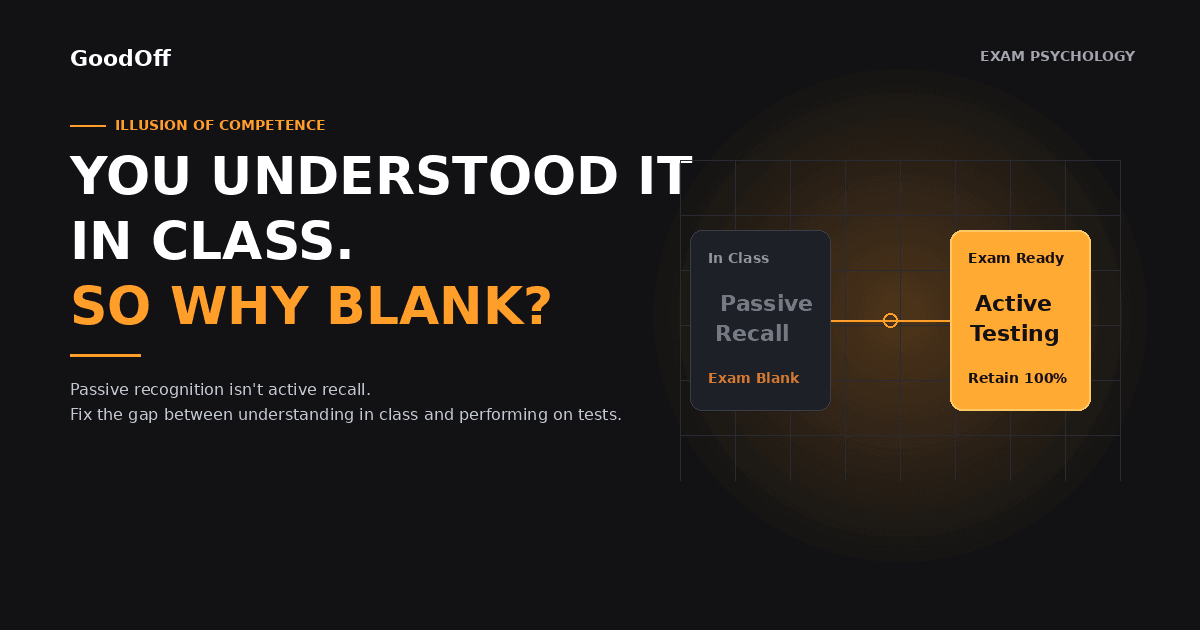
When you passively read over a page of text multiple times, your brain slips into a comfortable trap called the "illusion of competence." Because the text looks familiar, your mind falsely registers that you have mastered the material. Then, the moment the actual exam paper lands on your desk, your short-term memory blanks completely.
If you want to ace your curriculum without running yourself into chronic fatigue, you need to abandon passive consumption entirely.
Decades of rigorous cognitive science prove that Active Recall (forcing your brain to fish for data from deep within its neural pathways) and Spaced Repetition (reviewing information at precise, widening time intervals) are the absolute gold standards for long-term retention.
By applying these advanced structural hacks to these core principles, you can easily streamline your revision process, reduce study hours, and lock down complex terms effortlessly.
1. The Leitner Box 2.0: Dynamic Sorting For Weak Spots
The classic Leitner System utilizes physical or digital card boxes to schedule reviews based on accuracy. However, students frequently waste hours reviewing material they already know well.
To maximize efficiency, implement a compressed Dynamic Leitner Loop specifically designed for rapid exam turnarounds.
How to execute this framework:
Box 1 (The Emergency Block): Place brand-new cards or topics you consistently miss here. Review them every single day.
Box 2 (The Mid-Term Staging): Once you answer a card from Box 1 correctly, promote it to Box 2. Review these every three days.
Box 3 (The Mastery Vault): Correct answers from Box 2 move to Box 3, reviewed once a week.
The Nuclear Drop Rule: The second you get a card wrong in any box, it doesn't just drop down one level it drops completely back to Box 1.
Every time you answer a card correctly, it advances to the next box (from Box 1 to Box 2, and finally to Box 3) to be reviewed less frequently. However, if you hit a stumbling block and answer incorrectly, the card drops directly back to the daily block.
This hyper-aggressive sorting mechanism prevents you from spending valuable study time on concepts you have already consolidated, channeling 100% of your remaining cognitive bandwidth into your most stubborn blind spots.
2. Structural Question Chunking: The Reverse Note Taker
When compiling study guides, most students copy formulas or definitions word-for-word, creating a massive wall of text that is completely un-recallable.
To break this pattern, flip your note-taking process entirely on its head through Structural Question Chunking.
Instead of writing a factual statement in your outline, immediately rewrite it as a high-yield, specific question. If your lecture notes read: "Mitochondria synthesize ATP through the electron transport chain across the inner membrane," your study guide should read: "Where exactly does the mitochondrion generate cellular energy, and what specific pathway does it deploy?"
This simple semantic switch transforms your study notes from a passive reading asset into an active, self-contained examination engine. Every single time you open your outline, your brain is immediately forced to perform a retrieval operation before it can proceed down the page.
3. The Feynman Compression: Spotting Conceptual Gaps
Active recall is completely useless if you are simply memorizing raw syllables without understanding the underlying structural mechanism.
To ensure you actually comprehend the architecture of a concept, utilize The Feynman Compression Hack.
Step-by-step execution:
Identify a complex concept, system, or case study.
On a completely blank piece of paper, explain the concept out loud to an imaginary audience of high school students.
Strictly ban the use of any technical jargon, acronyms, or complex buzzwords.
The exact moment your explanation stumbles or relies on academic filler, you have pinpointed a structural gap in your knowledge.
Once identified, return directly to your primary materials to patch that precise vulnerability. True understanding requires being able to compress complex theories into simple, intuitive mental models. If you can't explain it simply, you don't actually understand it yet.
4. Multi-Sensory Audio Retrieval Loops
If sitting down to click through hundreds of digital flashcards feels paralyzing after a long day of classes, you can easily shift your retrieval loops to your auditory channels to beat focus burnout.
Record yourself reading your active recall questions out loud on your phone, leaving a deliberate 5-second window of absolute silence right after the question before speaking the correct answer.
You can seamlessly play these audio tracks while walking, commuting, or making dinner. When the question plays through your headphones, the brief window of silence forces your brain to mentally race to retrieve the answer before your own voice confirms it a few seconds later. It turns empty gaps in your schedule into high-leverage memory-building blocks without adding extra screen time to your day.
The Active Learning Implementation Matrix
Leitner Box 2.0
Primary Mechanism: Desirable Difficulty Allocation
Best Used For: Vocabulary, complex formulas, and dense technical terms.
Question Chunking
Primary Mechanism: Instant Retrieval Cueing
Best Used For: Restructuring massive textbook chapters into testable study outlines.
Feynman Compression
Primary Mechanism: Semantic Simplification
Best Used For: Breaking through dense theoretical architectures and legal or medical case studies.
Audio Retrieval Loops
Primary Mechanism: Spatial Memory Anchoring
Best Used For: Low-stress, hands-free review sessions during transit or daily downtime.
The Ultimate Takeaway
Academics who top their classes don't possess biological computing power that is vastly superior to yours; they simply deploy significantly better systems.
Stop treating your brain like a hard drive meant to passively store massive text files. Treat it like a muscle that only grows stronger when it is forced to lift heavy cognitive weight. Implement these active recall and spaced repetition loops, systemize your study blocks, and protect your free time while conquering your upcoming exams.