Master the SAT Exam with this comprehensive guide focused on active learning strategies like active recall, spaced repetition, flashcards, quizzes, and tracking your data to boost your score efficiently. Are you preparing for the SAT Exam and feeling overwhelmed by the sheer volume of material? Traditional cramming and passive reading rarely yield the high scores needed for top-tier college admissions. To truly dominate the test, you need to transition from passive reviewing to an active learning protocol.
By engaging your brain dynamically, you can retain complex math formulas, master reading passages, and sharpen your writing skills faster. Here is how to use evidence-based active learning strategies to conquer your SAT prep.
The Power of Active Recall and Spaced Repetition
Most students prepare for the SAT Exam by reading and highlighting prep books. Research shows this is one of the least effective study methods. Instead, you should rely on active recall. This technique forces your brain to retrieve information from memory without looking at the answer, strengthening neural pathways.
Pairing active recall with spaced repetition ensures you don't forget what you have learned. Instead of studying the same grammar rules every day, space out your review sessions over increasing intervals (e.g., 1 day, 3 days, 7 days). This flattens the forgetting curve and solidifies information in your long-term memory just in time for test day.
Ditch the Textbooks for Flashcards and Quizzes
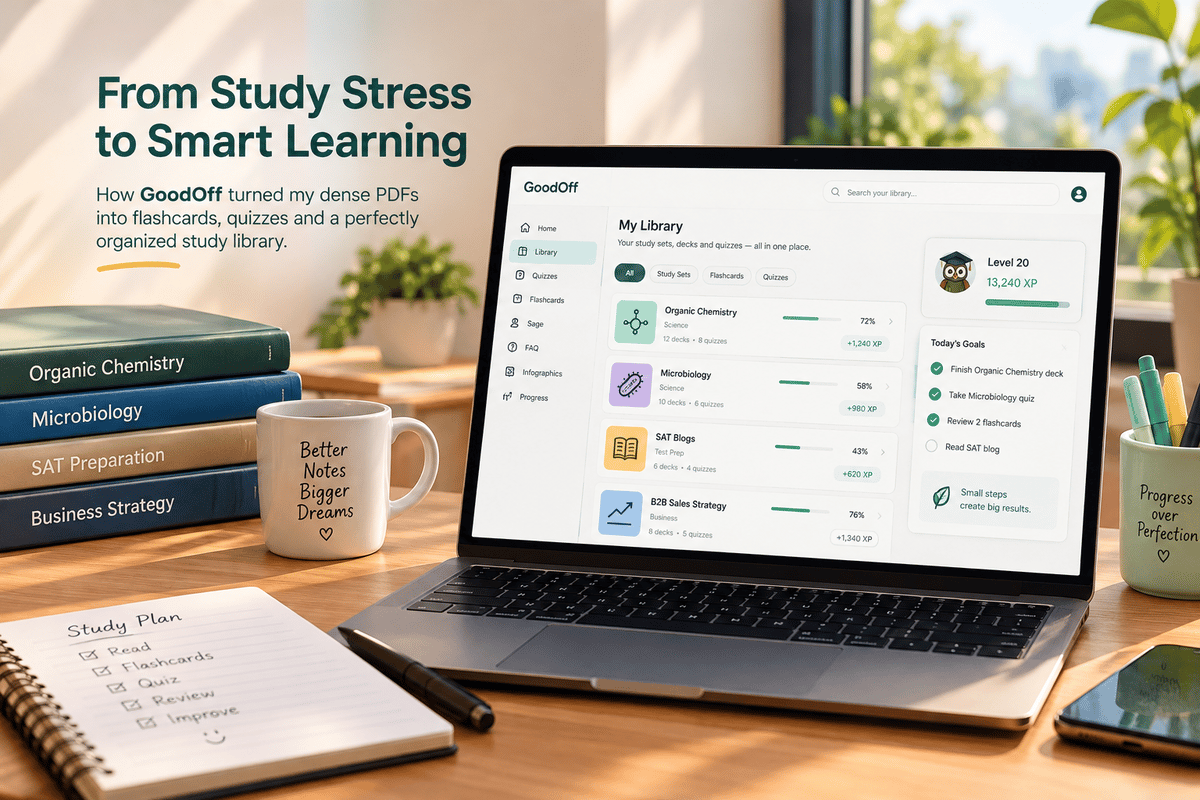
How do you implement these strategies practically? The answer lies in leveraging the right digital resources. You can explore how our GoodOff Active Learning Tools can streamline your prep by automating these exact techniques:
Flashcards: Use digital flashcards to master high-frequency SAT vocabulary and core math formulas (like the quadratic formula or circle equations). When you see a term, guess the definition or formula before flipping the card.
Quizzes: Regular, low-stakes quizzes simulate the actual pressure of the SAT Exam. Don't wait until the week before the test to take a practice exam. Quiz yourself daily on small chunks of material to identify your weak spots early.
Track Data to Maximize Your Improvement
You cannot improve what you do not measure. To make your SAT prep highly efficient, you must track data diligently. Keep a close eye on your analytics to see which sections whether it's heart of algebra, data analysis, or reading comprehension are pulling your score down.
Pro-Tip: If your quiz data shows a 40% accuracy rate in digital SAT geometry, shift your focus there immediately. Real-time metrics allow you to adjust your study plan dynamically, saving you valuable hours.
Structuring Your Daily Active Study Routine
To pull all of these elements together, structure your daily study sessions with a clear, cyclical routine:
Review (Learn): Spend 15 minutes reviewing a new SAT concept or formula.
Practice: Dive straight into targeted quizzes or interactive flashcards to apply what you just read.
Track: Check your performance dashboard to see how well you understood the material.
Improve: Re-attempt the questions you got wrong using an active AI tutor or detailed explanations until you achieve full mastery.
By transforming your study habits into an active, data-driven cycle, you will enter the testing center with complete confidence. To set yourself up for success, make sure to grab official practice materials and lock in your test date by visiting the College Board SAT Official Site