If you work anywhere near a school, as a teacher, a parent, an administrator, or just someone who reads too much education news, you already know that 2026 doesn't feel like a normal year. It feels like the year several slow-moving trends finally caught up with each other at once.
Enrollment is dropping. Federal funding is a question mark. AI went from "interesting pilot program" to "actually running parts of the school." And a whole generation of middle schoolers still hasn't recovered from a pandemic that ended years ago.
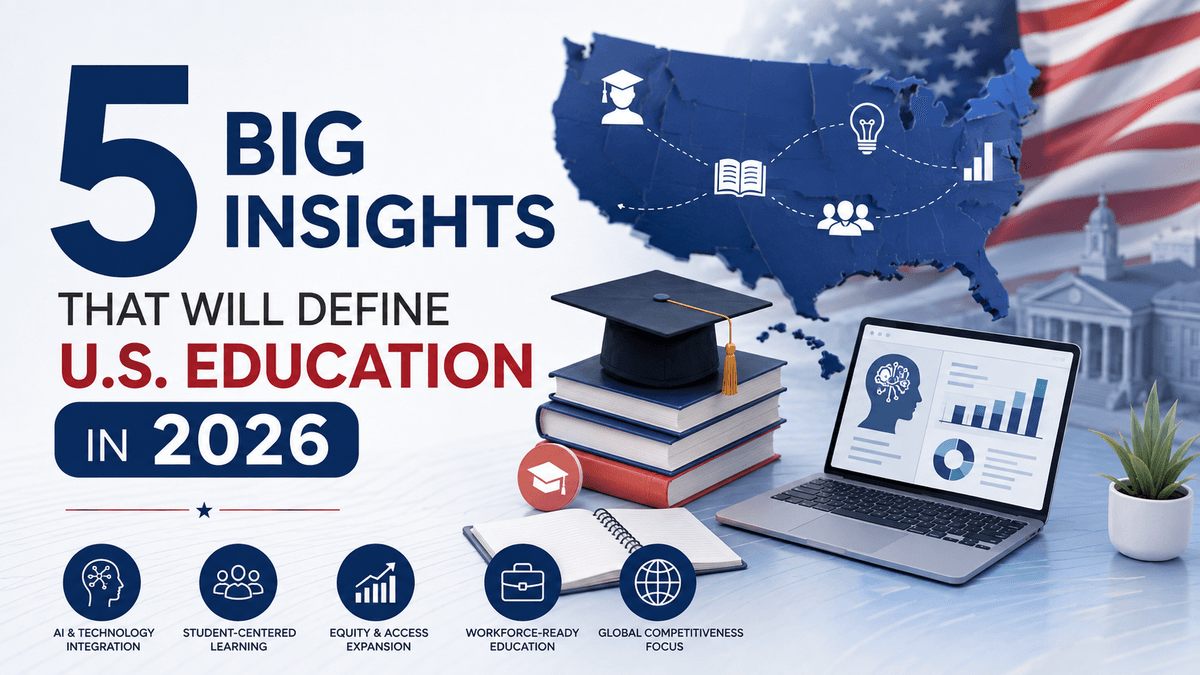
None of this is speculation dressed up as insight. It's what's actually showing up in the data, in district budget meetings, and in what researchers and policy analysts are saying right now. Here are five things worth understanding if you want to know where U.S. education is really headed this year.
1. The Middle School Literacy Crisis Is the Story Nobody's Fixing Fast Enough
Here's a number that should stop you in your tracks: only about 30% of eighth graders in the U.S. are reading proficiently, and no state has shown gains since 2022. The kids who were in kindergarten through third grade during COVID, the years when foundational reading skills get built, are now in middle school. And a lot of them never caught up.
This is being called the "engagement cliff," and it's not just about test scores. Middle school is where reading struggles start turning into disengagement, and disengagement is a lot harder to reverse than a skills gap.
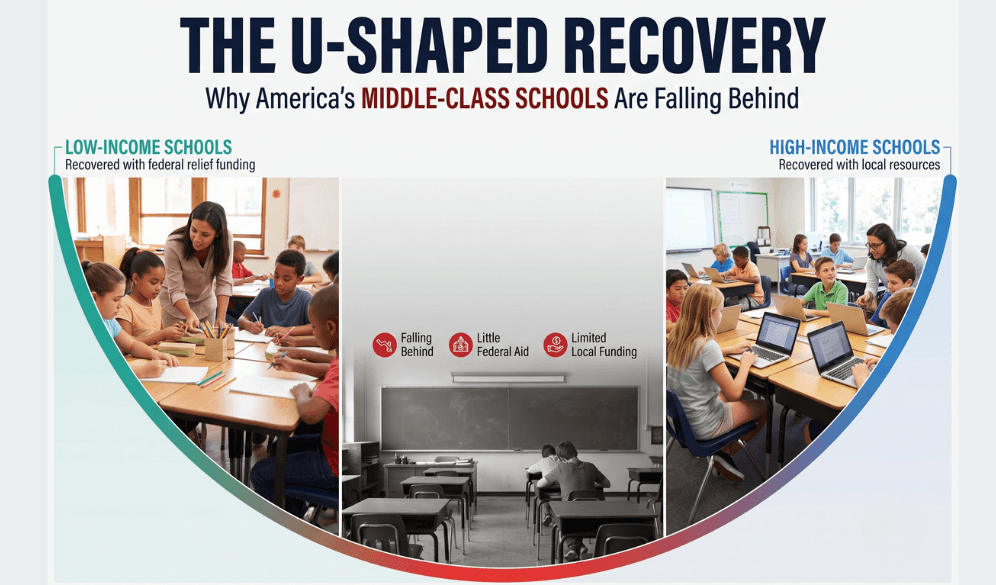
What makes 2026 different is timing. The emergency federal COVID relief money (ESSER funds) that many districts used to fund tutoring, extra reading specialists, and summer programs is gone. So districts are now facing a hard question: which of those recovery efforts do we keep paying for out of our own shrinking budgets, and which do we quietly let go?
Increasingly, researchers are pointing to summer learning programs as one of the more cost-effective, scalable ways to keep making progress, especially in math. But "cost-effective" still costs money, and that's the tension every district is sitting with right now.
2. AI in Schools Is Moving From "Pilot Project" to "Infrastructure"
For the last couple of years, AI in education has mostly meant a teacher here or there experimenting with a chatbot, or a district running a small pilot with an adaptive learning tool. That phase is ending.
The conversation has shifted from isolated tools to actual infrastructure: AI is getting built into the systems schools already run on, including grading workflows, tutoring support, predictive analytics that flag which students are at risk before they fall too far behind, and professional development for teachers that's tailored to what they individually need rather than a one-size-fits-all training day.
Higher ed is moving even faster on this. Surveys show the vast majority of colleges and universities plan to expand their AI use within the next two years, and a large share expect to lean on AI specifically for enrollment forecasting and admissions modeling, trying to predict who's likely to apply, enroll, and stay.
But here's the honest part: adoption is outpacing governance. Most institutions are further along in deploying AI tools than they are in deciding who's accountable when those tools get something wrong, or how student data gets protected along the way. That gap is going to be one of the defining tensions of the next few years, not just 2026.
3. The "Demographic Cliff" Just Became a Math Problem, Not a Metaphor
Higher education has been warning about a coming enrollment cliff for years, the idea that declining birth rates would eventually shrink the pool of college-aged students. In 2026, that warning stopped being theoretical.
The number of 18-year-olds in the U.S. peaked in 2025. This year marks the start of what's expected to be a 15-year slide in first-time undergraduates. Add to that a sharp drop in new international student enrollment, down significantly this past fall due to visa issues and geopolitical friction, and you get a genuinely difficult financial picture for a lot of colleges, especially smaller and mid-sized ones that don't have huge endowments to fall back on.
It's not just a higher-ed problem, either. On the K-12 side, public school enrollment is also declining in many states, partly due to demographics and partly due to families choosing charter schools, private schools, or homeschooling instead. Fewer students eventually means less per-pupil funding, which means harder choices about which programs and staff positions survive.
The response taking shape across higher ed is a pivot toward non-traditional students: adults returning to school, dual-enrollment high schoolers, and people looking for shorter, workforce-focused credentials instead of a full four-year degree. Whether that pivot happens fast enough to offset the shrinking traditional pipeline is the open question.
4. Federal Policy Uncertainty Is Now a Permanent Planning Variable
Education leaders are used to policy shifting when a new administration comes in. What's different in 2026 is the sheer amount of it happening at once, and how unevenly it's landing.
The push to shrink or dismantle parts of the U.S. Department of Education has raised real concerns among researchers about the future of national data collection, the kind of data that lets schools, states, and journalists actually track how students are doing over time. If that data pipeline weakens, it becomes harder for anyone to know whether interventions are working.
Meanwhile, federal immigration enforcement has had a ripple effect that shows up far from any policy memo: some families are keeping kids home from school out of fear, which shows up as an attendance and enrollment problem long before it shows up as a policy headline.
Funding itself is expected to stay relatively flat but unpredictable, not a dramatic cut, but also not the stability districts need to plan multi-year programs with confidence. And state-level accountability policy is pulling in opposite directions at once: some states are tightening academic standards and grading systems, while others are loosening them. There's no single national direction right now. There are fifty different experiments running in parallel, and district leaders are the ones left to interpret what it all means for their own budgets and classrooms.
5. Skills and Credentials Are Quietly Reshaping What "Higher Education" Even Means
For a long time, the four-year degree was the default answer to "what comes after high school." That default is weakening, and 2026 is a notable turning point because of one specific policy change: the arrival of Workforce Pell, which extends federal financial aid eligibility to shorter, high-quality non-degree credential programs.
This matters more than it might sound like on paper. It gives students, and especially adult learners looking to reskill, a federally backed path into shorter certificate programs tied directly to job outcomes, without requiring a full degree. Combined with growing dual-enrollment programs that let high schoolers start earning college credit early, the on-ramps into higher education are diversifying in a way they haven't in decades.
On the flip side, colleges are under real financial strain. Hiring freezes are widespread, merit raises are shrinking, and a large majority of faculty appointments are now non-tenure-track roles rather than the traditional tenure path. That's driving more interest in faculty unionization and raising legitimate questions about job security and academic quality at the same time.
Put simply: the pathway into a career is diversifying for students, right as the institutions offering those pathways are financially squeezed and restructuring how they staff themselves. Both things are true at once, and 2026 is the year that contradiction becomes hard to ignore.
What This Actually Means
None of these five insights exist in isolation, that's really the point. A district trying to close the literacy gap is also managing enrollment decline. A university excited about AI-driven personalization is also navigating hiring freezes and a shrinking pool of 18-year-olds. Federal uncertainty touches every one of these threads at once.
2026 isn't the year education gets "disrupted" by one big headline trend. It's the year several long-building pressures, pandemic recovery, demographics, technology, and policy, stop moving separately and start moving together. That's harder to summarize in a soundbite, but it's a much more honest picture of where things actually stand.
Try goodoff