Software engineering interviews have changed. Gone are the days of just knowing a bit of syntax; today, it’s about deep problem-solving and algorithmic efficiency. With thousands of applicants for every role, the competition is intense. But here is the reality: most developers prep the wrong way passively watching tutorials, "reading" solutions, and doing random LeetCode problems without a system.
In 2026, you don't need more hours; you need better systems. AI-powered tools, active recall, and spaced repetition can help you master Data Structures and Algorithms (DSA) in half the time. This guide outlines an 8-week roadmap to landing your dream tech offer.
Why Your Current Study Method is Failing
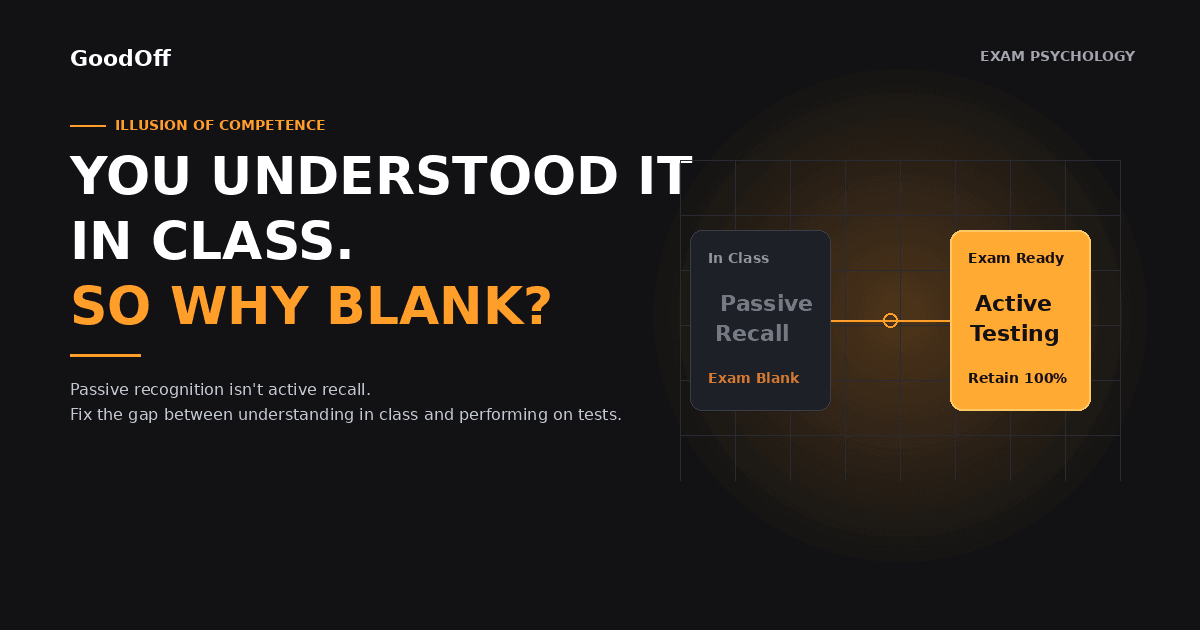
Most people suffer from the "Illusion of Competence." You watch a coding video, understand it, and think you’ve learned it. But when the compiler is blank during an interview, you freeze.
Passive Learning: Watching others code doesn't build mental muscle.
No Retention: You solve a Linked List problem today but forget the logic in two weeks.
Lack of Structure: Jumping between topics without mastering foundations.
To beat the curve, you need a loop: Learn → Practice → Track → Improve.
Week 1-2: The Foundation & Patterns
Don't start with hard problems. Master the "Patterns" first.
Big O Notation: If you can't analyze time and space complexity, you can't optimize.
Core Data Structures: Arrays, Strings, Hash Maps, and Linked Lists.
The Diagnostic: Take a mock assessment on HackerRank to see where you stand.
GoodOff Integration: Use GoodOff to create flashcards for time complexities and pattern recognition (e.g., "When do I use Two Pointers?"). Instead of memorizing code, use AI to generate cards that test your logic and edge cases.
Week 3-4: Diving into Intermediate Patterns
Now, move to patterns that cover 80% of interview questions:
Sliding Window & Two Pointers: Essential for array/string optimization.
Recursion & Backtracking: The base for trees and graphs.
Stack/Queues: Master these for BFS and DFS traversal.
Week 5-6: The "Review or Die" Phase
This is where most candidates fail. They solve 100 problems but remember none. The Review Protocol: For every problem you solve (or fail):
Identify the core pattern.
Note the "Aha!" moment (the trick that solved it).
Add it to your GoodOff spaced repetition deck.
GoodOff’s algorithm ensures you revisit that "Binary Search on Answer" logic exactly when you're about to forget it, moving it from short-term to long-term memory.
Week 7-8: Simulation & Mock Interviews
The final stretch is about pressure handling.
Timed Sprints: Solve 2 Medium problems in 45 minutes.
Mock Interviews: Use platforms like Pramp to practice explaining your thoughts out loud.
Final Polish: Review your GoodOff "Mistake Deck" daily. These are your personalized weak points that the AI has been tracking.
Why AI Tools Like GoodOff are a Cheat Code
Traditional coding prep is a "grind." AI-driven prep is an "optimization."
Targeted Recall: Don't waste time on what you know. Focus on what the algorithm knows you're struggling with.
Instant Summaries: Upload a complex DSA article, and let GoodOff turn it into a 5-card summary.
Human-Friendly Analytics: Track your progress with real-time feedback that tells you exactly when you’re ready for the "Big Tech" level.
The Bottom Line
Coding interviews aren't just an IQ test; they are a preparation test. An 8-week plan built on active recall and spaced repetition will beat "grinding" every single time. Stop staring at solutions and start building a memory that lasts.