The Science of Spaced Repetition: Why Decks and Quizzes Outperform Reading
You’ve likely experienced the "vanishing act": you spend three hours Sunday night mastering a concept, only to stare blankly at your exam paper on Wednesday. It feels like your brain has a leak.
The truth is, it does. In the late 19th century, psychologist Hermann Ebbinghaus coined the "Forgetting Curve," proving that we lose roughly 70% of new information within 24 hours if we don’t actively review it. The traditional student response? Reread the chapter. But science says there’s a much better way.
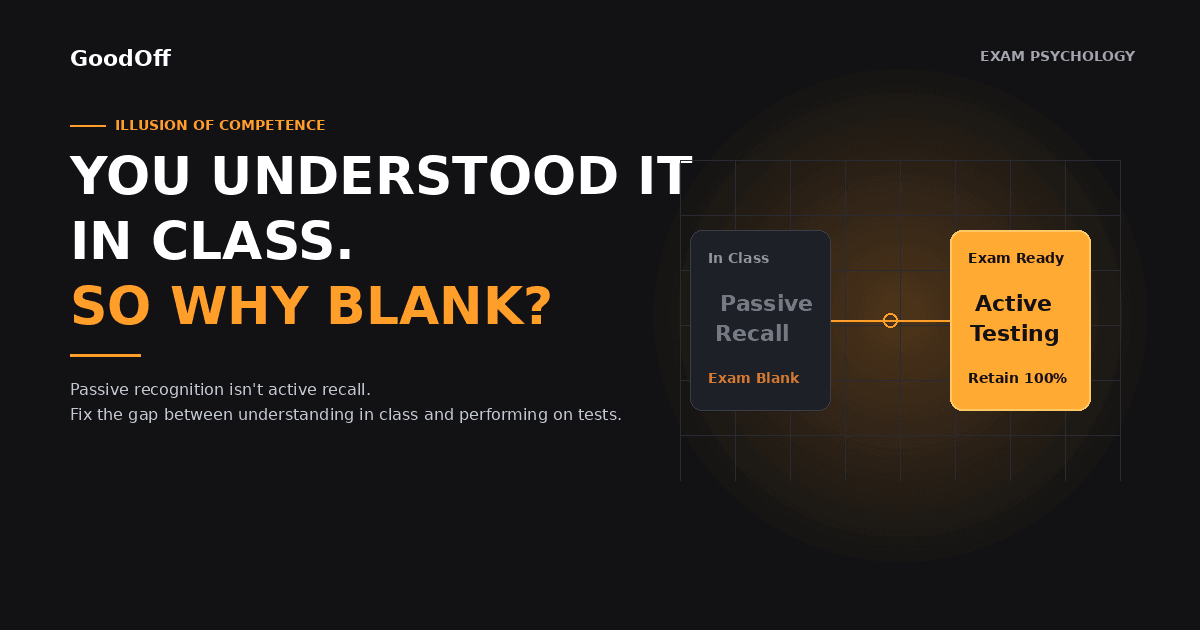
The "Input vs. Retrieval" Trap Most students focus on input stuffing facts into their heads through reading and highlighting. This creates a "fluency illusion," where the material looks familiar, so you think you know it. Real learning happens during retrieval the hard work of pulling information out of your brain.
Enter Spaced Repetition Spaced Repetition Systems (SRS) exploit the "spacing effect." Instead of reviewing a flashcard every day, you review it just as you are about to forget it.
Day 1: Learn the concept.
Day 2: First review.
Day 7: Second review.
Day 30: Third review.
Each time you successfully recall the info, the memory trace becomes stronger and the "forgetting curve" flattens.
How to Automate Your Memory Manually tracking these intervals is a nightmare. That’s why we built GoodOff. Our algorithm tracks your performance on every deck and quiz, automatically surfacing the cards you struggle with and pushing back the ones you know by heart.