
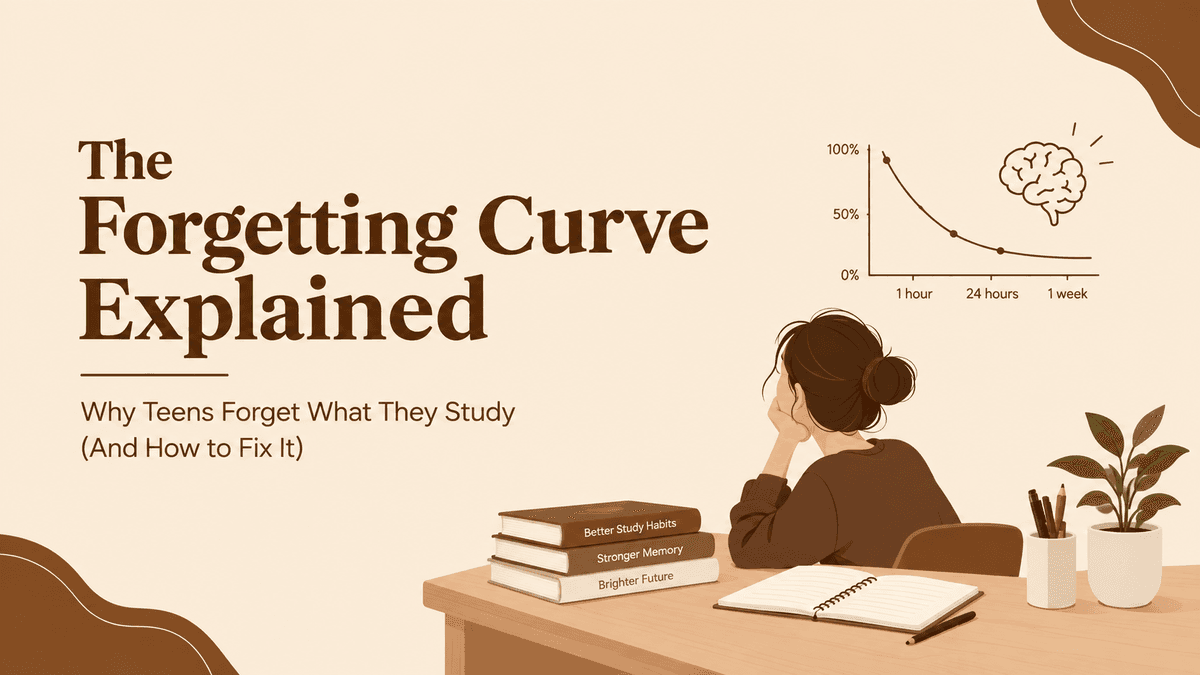
Discover the science behind the forgetting curve and why teens forget most of what they study within hours. Learn proven techniques like spaced repetition, active recall, and self testing to remember more and study smarter.
Have you ever crammed all night for a test, walked in feeling confident, and then blanked halfway through? Or maybe you aced a quiz on Friday and forgot half of it by Monday.
If that sounds familiar, you're not bad at studying. You're just up against something your brain does automatically: forgetting. The good news is that once you understand how forgetting actually works, you can start working with your brain instead of against it.
What Is the Forgetting Curve
Back in the 1880s, a psychologist named Hermann Ebbinghaus ran a simple but eye opening experiment on himself. He memorized random lists of nonsense syllables, then tested his own memory at different time intervals to see how much he had lost.
What he discovered is now called the forgetting curve, and the numbers are pretty rough.
Within 1 hour, you forget about half of what you just learned
Within 24 hours, you're down to remembering roughly 30 percent
Within a week, without any review, you might only hold onto 10 to 25 percent
In simple terms, if you study something once and never come back to it, your brain assumes it's not important and quietly clears it out to make room for other things.
This isn't a flaw in how your brain works. It's actually doing its job. Your brain can't hold onto everything, so it keeps what shows up again and again. The tricky part is that school often expects you to learn something once and still remember it weeks later during finals.
Why Cramming Feels Like It Works (But It Doesn't Really)
Cramming gets a bad reputation, but let's be honest, it does work in the short term. If you cram the night before a quiz, you can probably pass it.
Here's the catch though. That memory only sits in short term storage. It hasn't gone through enough review to move into long term memory, so it fades fast. That's why so much of what you crammed for last year is basically gone now.
If your goal is just to pass tomorrow's quiz, cramming can get you there. If your goal is to actually know the material for finals, entrance exams, or college, cramming alone won't cut it.
How to Beat the Forgetting Curve
The trick isn't studying harder. It's studying at the right times. Here are five techniques that actually work, backed by years of memory research.
1. Spaced Repetition
Instead of studying something once for two hours straight, spread it out. Review it a little today, then again in two days, then in a week, then in a month. Each time you revisit it right before you're about to forget it, your brain treats it as important and holds on tighter.
A simple schedule to try:
Day 1: Learn it
Day 2: Quick review, about 10 minutes
Day 4: Quick review
Day 7: Quick review
Day 14: Quick review
Apps like Anki or Quizlet can automate this for you, but Goodoff takes it further with features like podcasts, FAQs, and much more, all in one place.
2. Active Recall Instead of Rereading
Rereading your notes feels productive, but it's actually one of the weakest study methods out there. Your brain recognizes the information without truly retrieving it, so it feels familiar even when you haven't really memorized it.
Try this instead:
Close your notes and write down everything you remember
Use flashcards where you say the answer out loud before flipping the card
Explain the topic to someone as if they know nothing about it
If you can't recall something without peeking, that's exactly what you need to review again.
3. Test Yourself Early and Often
Practice tests, old quizzes, and self made questions aren't just there to check what you know. The act of testing itself actually strengthens memory. This is known as the testing effect, and it outperforms most other study methods.
4. Get Enough Sleep
Your brain consolidates memories while you sleep, moving them from short term to long term storage. Pulling an all nighter to cram doesn't just leave you tired. It can actually undo some of the progress you made in earlier study sessions.
5. Mix Up What You Study
Instead of studying one topic for three hours straight, mix related topics in the same session. For example, switch between algebra, geometry, and word problems instead of drilling only one type. It feels harder while you're doing it, but it builds stronger, more flexible memory.
Final Thoughts
Forgetting isn't a personal failure. It's simply how brains are built. Students who seem to remember everything usually aren't smarter than everyone else. They're just reviewing smarter, spacing things out, testing themselves, and catching information right before it slips away.
Next time you sit down to study, don't just ask how long you should study for. Ask when you're coming back to review it. That one shift is often the real difference between cramming and actually learning.