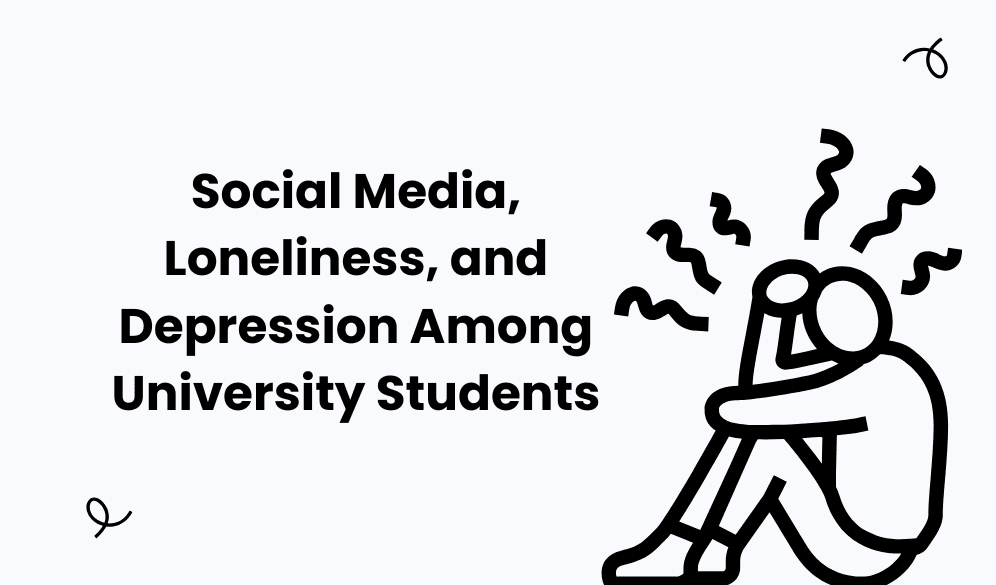
Why does being hyper-connected leave undergraduates feeling completely alone? Explore the clear link between social media and college depression. Log onto any university student’s phone, and you will find an ecosystem designed for hyper-connectivity. From campus-wide group chats and Discord servers to Instagram reels and TikTok feeds, undergraduates are theoretically more in touch with their peers than any generation in human history.
Yet, a profound, alarming paradox defines higher education today: the more digitally connected a student is, the lonelier they are likely to be.
While campus marketing emphasizes vibrant digital communities, the empirical data paints a far more troubling picture. In early 2026, a groundbreaking study published in the Journal of American College Health surveyed tens of thousands of young adults ages 18 to 24. The researchers discovered that over 54% of college students currently experience chronic loneliness and the odds of severe isolation skyrocket among heavy social media users. Far from bridging social gaps, a digital-first lifestyle is directly accelerating the surge of social media and college depression.
To understand why our primary tools for connection are fueling a mental health crisis, we must look at the hidden psychological mechanics driving today's campus experience.
1. The Digital Connection Paradox
For a freshman or returning student, social media acts as an emotional placeholder. It fills the quiet, uncomfortable gaps of the day waiting for a lecture to begin, sitting alone in the dining hall, or lying in a dorm room at night.
What recent university research highlights, however, is a clear threshold effect. When a student crosses the threshold of just two hours a day (approximately 16 hours a week) on social platforms, their risk of experiencing profound student loneliness climbs by 19%. For the heaviest users those logging 30 or more hours weekly the likelihood of severe isolation surges by an astonishing 38%.
The issue isn't inherently the technology itself; it is what the technology replaces. Time spent tracking algorithmic updates seamlessly crowds out the messy, spontaneous, face-to-face interactions that form the structural foundation of real human belonging.
2. The Trap of Social Comparison Theory
On a university campus, social media functions as a highly curated marketplace of success. Students don't just see their peers; they see stylized, flawless portrayals of their peers' social lives, academic achievements, and physical appearances.
According to classic social comparison theory, humans evaluate their own worth by measuring themselves against others. When an undergraduate constantly scrolls through idealized feeds while sitting alone, a toxic internal narrative takes root: “Everyone else is thriving, finding their lifelong friend groups, and acing their classes, while I am completely failing at the college experience.” This algorithmic loop fuels a deep sense of social inadequacy, directly converting passive scrolling into acute depressive symptoms.
3. Passive Scrolling vs. Active Engagement
A key insight emerging from sociological studies points directly to how students interact with their screens:
Active Engagement: Using digital platforms to directly schedule real-world meetups, coordinate study groups, or converse one-on-one with trusted peers offers a protective, stabilizing effect on mental health.
Passive Scrolling: Mindlessly consuming algorithmic content feeds, tracking view counts, or observing group dynamics from afar creates a toxic spectatorship.
Passive consumption reduces a student from an active participant in campus life to a detached, hyper-critical observer, intensifying feelings of alienation and compounding digital fatigue.
The Cycle of Digital Isolation on Campus
The Behavioral Trigger: A student experiences initial campus anxiety or awkwardness, choosing to retreat into a smartphone screen for immediate comfort.
The Algorithmic Loop: Hours of passive scrolling expose the student to idealized peer highlights, triggering severe social comparison.
The Emotional Outcome: Real-world interactions are entirely replaced by digital spectatorship, leading to acute student loneliness and a higher risk of clinical depression.
4. When Digital Escape Becomes Academic Deficit
The emotional toll of digital isolation quickly bleeds into a student's academic performance. Excessive platform use frequently leads to compulsive multitasking, drastically shattering cognitive focus.
When a student relies on an infinite scroll to cope with underlying anxiety, their capacity for deep focus erodes. Deadlines pass unmet, assignment folders pile up, and test scores drop. This toxic intersection—where digital distraction causes academic slip, and academic failure worsens baseline anxiety—forms a destructive loop that leaves many students feeling entirely paralyzed.
"Social media is intentionally engineered to hijack our dopamine systems. When it replaces the authentic interpersonal discomfort required to build real-world relationships, socializing becomes a neglected muscle that quickly atrophies."
Reclaiming the Campus Experience: Actionable Steps
Reversing the tide of social media and college depression requires moving past hollow "screen time" warnings and adopting functional, protective boundaries.
Enforce an Offline Study Window: Treat study sessions as digital-free zones. Put your phone on "Do Not Disturb" and place it physically out of sight inside a backpack. Removing the visual cue of the device prevents attention fragmentation and protects your cognitive energy.
Audit Your Platform Choices: Visually-driven, algorithmic platforms trigger significantly higher rates of anxiety and body-image struggles than text-focused or collaborative tools. Pay close attention to how you feel after using specific apps, and intentionally delete or restrict those that leave you feeling drained.
Lean into Controlled Discomfort: Building an authentic campus community requires stepping into spaces where you don’t know anyone. Join campus clubs, participate in intramural sports, or commit to working on group projects in person. Real-world connections are the most effective, evidence-based buffer against loneliness.
If you are currently feeling disconnected on campus, remember that the digital representations of life around you are heavily distorted. True community is never built on a screen it is built in the shared, unedited, and authentic moments of daily life.