Discover how successful students maximize their learning efficiency using science-backed study tips. Move past passive reading and master active recall, spaced repetition, and interleaving to transform your academic performance.
For decades, the image of a successful student was someone buried under an avalanche of textbooks, clutching a neon yellow highlighter, and surviving on midnight coffee. Many students still pull exhausting all-night cramming sessions, believing that sheer hours equal academic success.
Cognitive science tells a completely different story.
The students topping the leaderboard are not necessarily studying longer; they are studying completely differently. They have traded passive, low-utility techniques for high-yield, evidence-based habits. By aligning their routines with how the human brain naturally processes, stores, and retrieves data, these top performers achieve better grades in a fraction of the time.
If you want to upgrade your academic performance, it is time to dismantle old habits and adopt the exact strategies successful students use to learn.
The Illusion of Competence
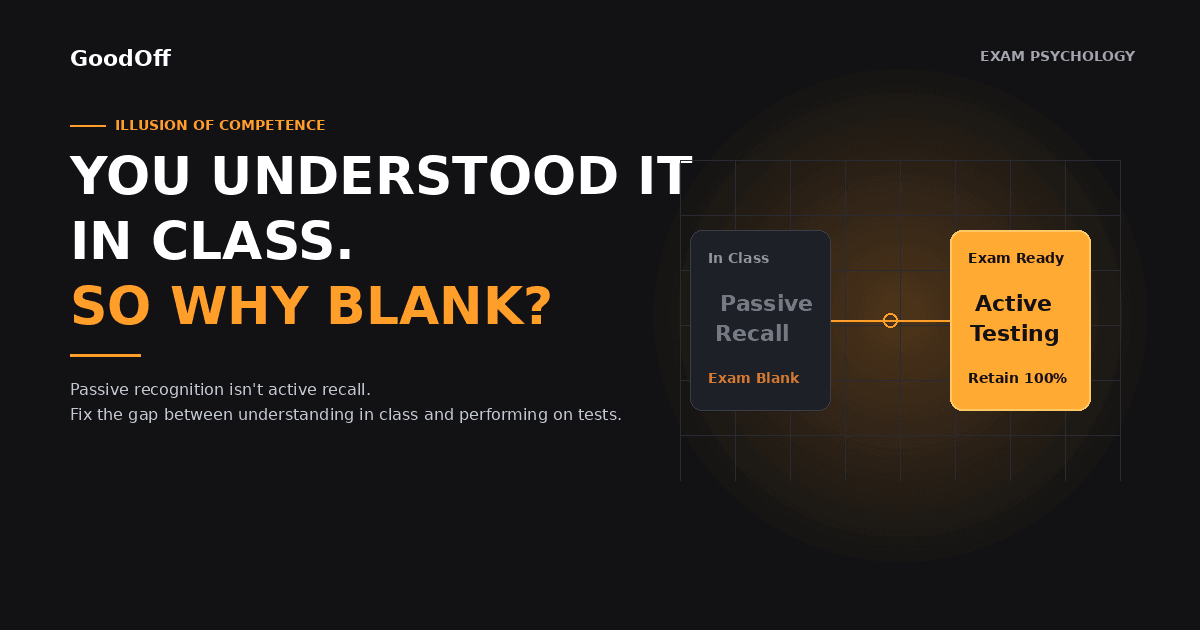
Most traditional revision habits feel productive but are scientifically proven to fail. Rereading a textbook chapter, highlighting blocks of text, and reviewing completed notes create what cognitive psychologists call the illusion of competence.
Passive Recognition: When you read a familiar sentence, your brain recognizes the information and mistakes this passive recognition for actual mastery.
The Exam-Day Blank: You feel like you know the material, but when you are forced to retrieve that information from a blank canvas during an exam, your memory blanks.
Mental Effort: Real learning requires active friction. If your revision feels too easy, your brain is not building the durable neural pathways required for long-term retention.
1. Force Your Brain to Work with Active Recall
High-achieving students do not spend time putting information into their heads; they spend time trying to pull it out. This method is known as active recall or retrieval practice.
A landmark study by Roediger and Karpicke revealed that students who practiced active recall retained 80 percent of the material after one week, whereas students who passively reread the text retained only 34 percent. Every time you force your brain to retrieve a piece of information without looking at your notes, you strengthen the neural connections associated with that memory.
How to Apply It
The Blurting Method: Read a section of your textbook for fifteen minutes, close the book, and rapidly write down everything you can remember on a blank piece of paper. Open the book and check what you missed.
Flipped Note-Taking: Instead of writing linear summaries, write your notes as a series of questions. When you review your material later, treat your notebook like a self-administered test.
Digital Retrieval: Maximize your efficiency by using the interactive GoodOff digital flashcard decks, which force your brain to engage in active retrieval practice rather than passive reviewing.
2. Flatten the Forgetting Curve Using Spaced Repetition
In the late nineteenth century, psychologist Hermann Ebbinghaus discovered the forgetting curve, a mathematical formula showing that humans lose roughly half of new information within days if it is not reviewed. Cramming works temporarily for tomorrow morning's quiz, but the information completely vanishes shortly after.
Successful students bypass this by using spaced repetition. Instead of reviewing a concept four times in one night, they spread those reviews out over days, weeks, or months using a structured timeline:
Day 1: Initial Learning
Day 2: First Recall
Day 5: Second Recall
Day 14: Third Recall
Systematic Interruptions: By spacing out your reviews, you deliberately interrupt the forgetting curve at the exact moment your brain is about to let go of the information.
Memory Consolidation: This process signals to your hippocampus that the data is critical, shifting it from short-term memory to permanent neocortical storage.
Automated Systems: To learn how to structure these review intervals automatically, explore the foundational guidelines on the Harvard University Academic Resource Center for managing cognitive load.
3. Break Up Block Studying with Interleaving
When preparing for an exam, the standard approach is block studying: mastering topic A completely before moving on to topic B. While this provides a temporary confidence boost, it harms long-term test performance.
Top students use interleaving, which means mixing up different topics or problem types within a single study block. If you are practicing mathematics, do not solve twenty calculus problems using u-substitution back-to-back. Instead, mix in an integration-by-parts problem, then a geometry question, then go back to calculus.
Context Evaluation: Interleaving forces your brain to constantly evaluate the context of a problem.
Exam Preparedness: On a final exam, questions are randomized. If you have only practiced block studying, you will struggle to identify which formula to apply when the context shifts.
Dynamic Training: Interleaving trains your brain to select the right tool for the right job, a method heavily supported by the APA PsycNet research database on cognitive skill acquisition.
Make Your Brain Work Smarter
Academic success is the byproduct of effective systems, not biological luck. By shifting your focus from passive input to active output, you can drastically cut down your desk hours while watching your comprehension skyrocket. Stop highlighting, start retrieving, and let cognitive science handle the heavy lifting.