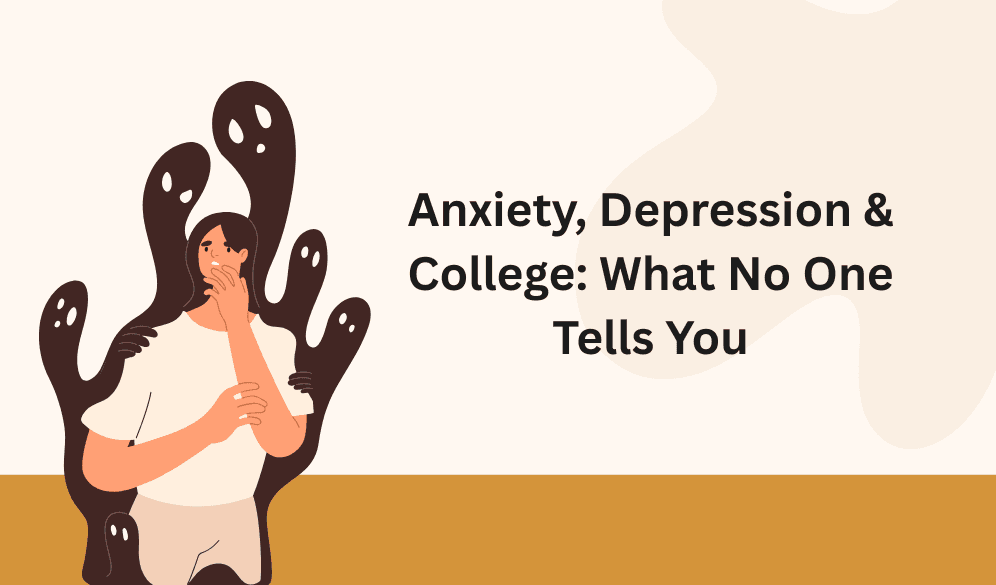
If you are sitting in your dorm room feeling completely directionless and invisible, read this. Discover why feeling lost in college is incredibly common.
It is past midnight, and the campus outside is finally quiet. You are staring at your laptop screen or looking at the concrete wall of your dorm room, and a heavy, hollow question starts creeping into your mind:
“What am I even doing here?”
On paper, everything looks exactly the way it is supposed to. You registered for classes, you bought the textbooks, and you walked across the quad. But internally, you feel like an absolute imposter. You feel completely directionless, disconnected from the people around you, and terrifyingly invisible.
If you are feeling lost in college right now, here is the absolute truth that campus orientation completely left out: You are currently experiencing the most common, unspoken reality of higher education.
The glossy brochures show students who have it all figured out, laughing on sunny lawns. They don't show the thousands of undergraduates who are quietly enduring an identity crisis. Let’s look at the hidden psychological mechanics of why college makes us feel so incredibly ungrounded and why you aren't failing just because you feel confused.
1. The Shock of the "Blank Slate" Identity Crisis
When you live at home and attend high school, your life has a built-in structural framework. Your identity is largely anchored by your family, your childhood friends, your hometown geography, and a rigid daily schedule. You know exactly who you are because your environment constantly tells you.
When you step onto a university campus, that entire framework vanishes overnight.
Suddenly, you are completely responsible for defining who you are, what you care about, and what you want to do with the rest of your life. This sudden shift often triggers a profound college student identity crisis. Having a completely blank slate sounds liberating, but in reality, it can feel like floating in deep space without a tether. The sudden absence of familiar anchors makes a severe bout of anxiety and confusion a completely logical response.
2. The Mirage of "The Perfect Squad"
A primary source of pain for students is the toxic myth of the instant friend group. During the first few weeks of the semester, there is an unspoken, desperate scramble to find community. You see massive groups walking to the dining hall or posting photos together online, and you assume they have found lifelong bonds.
[ What You See ] ──► A massive, laughing group on the quad (Looks like lifelong friends).
[ The Reality ] ──► Hyper-connectivity masking deep campus loneliness.
What no one tells you is that those early groups are almost always built on mutual survival, not genuine connection. Clinging to the nearest person out of sheer freshman year adjustment anxiety is incredibly common. When those superficial connections naturally begin to fade, it leaves many students drowning in deep campus loneliness, convinced that everyone else has successfully found their place while they remain entirely on the outside.
3. Imposter Syndrome in a Hyper-Competitive Space
College exposes you to a concentrated pool of highly driven, talented peers. If you were a top student in your high school, sitting in a lecture hall surrounded by hundreds of other top students can completely shatter your self-esteem.
This environment breeds severe imposter syndrome in college. Every time a classmate drops a complex industry term during a seminar, or posts a massive corporate internship update on LinkedIn, your brain converts it into a personal failure. You start believing that the admissions office made a profound mistake by letting you in, turning basic academic challenges into an agonizing proof of your own inadequacy.
The True Architecture of feeling Unanchored
The Social Disconnect: Being physically surrounded by thousands of people every single day while lacking a single deep, authentic connection.
The Academic Spiral: Changing your major or watching your grades slip, leading to a total loss of confidence in your future career path.
The Routine Burnout: Lacking basic daily structure, causing you to sleep through lectures, ignore basic self-care, and feel completely paralyzed.
4. The Dangerous Myth of "The Linear Path"
We are conditioned to believe that life is a straight line: you pick a major at 18, you graduate at 22, and you climb a single corporate ladder until you retire.
But humans do not develop linearly. Higher education is fundamentally designed to be a messy, disruptive process of trial and error. It is a space meant for breaking down old assumptions and building new ones. When you change your major, question your career goals, or realize you don't actually like the path you chose, you aren't falling behind you are actively participating in the exact self-discovery that college is meant to facilitate.
"Feeling entirely lost is not proof that you don't belong here. It is proof that you are actively growing out of the old version of yourself, and your new foundation hasn't finished drying yet."
How to Find Your Grounding Anchors
If you are currently sitting in your room feeling entirely invisible and directionless, you cannot fix it by forcing a massive life transformation overnight. Instead, implement a few tiny, protective boundaries to help you stop drifting:
Lower the Friendship Stakes: Stop trying to find a massive "squad" or an entire network of peers. Focus all of your social energy on finding just one or two people with whom you can have a quiet, completely honest conversation. One authentic relationship is a perfect shield against isolation.
De-Optimize Your Time: Give yourself permission to do things that have absolutely zero resume value. Read a fiction book, take a walk on a new part of campus without checking your phone, or watch a comfort movie. Step out of the competitive hustle culture.
Anchor a Single Daily Routine: When everything feels completely chaotic, pick one tiny physical habit and commit to it at the exact same time every day. Wake up at 8:00 AM, buy a coffee from the exact same shop at 10:00 AM, or go to the gym at 5:00 PM. External structure creates internal predictability.
You are not the only one sitting in the dark tonight wondering if you made a massive mistake. The person getting the highest grade in your class and the peer with the perfect social feed are often carrying the exact same sense of displacement. Be incredibly gentle with yourself right now finding direction in university takes time, and simply surviving the adjustment is a massive victory.