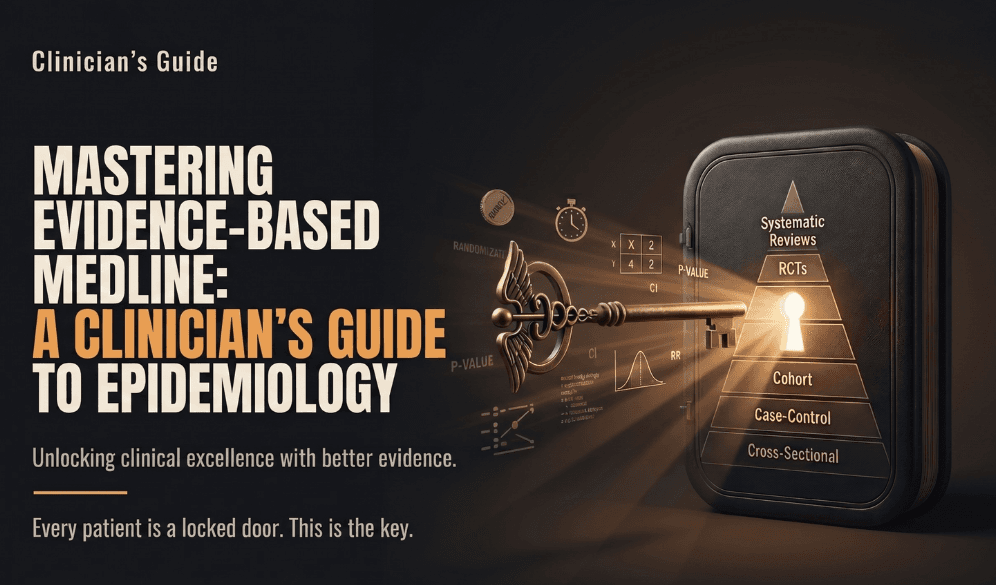
Why Epidemiology Matters in Everyday Medicine
Imagine a doctor seeing two patients with the same disease.
One patient improves quickly after treatment. The other does not.
The doctor naturally wants to know why.
Was the treatment effective? Was the disease more severe in one patient? Did another health condition influence the outcome? Was the diagnosis accurate? Or could the difference simply be due to chance?
These are not just clinical questions. They are epidemiological questions.
Epidemiology gives healthcare professionals a structured way to understand how diseases occur, what factors influence health outcomes, how effective treatments really are, and whether research findings can be trusted.
It is often associated with outbreaks, population statistics, and public health. But its value extends much further. Modern clinical practice depends heavily on epidemiological thinking, from interpreting research papers and assessing diagnostic tests to choosing treatments and explaining risks to patients.
The goal is not to turn every clinician into a statistician. It is to help clinicians ask better questions and make better decisions.
What Is Epidemiology?
At its heart, epidemiology is the study of health-related events and their distribution and determinants in populations, together with the application of that knowledge to control health problems.
This definition contains several important ideas.
First, epidemiology looks at populations, not just individual patients.
Second, it asks how health events are distributed. Who develops a disease? Where does it occur? When does it occur? How frequently?
Third, epidemiology looks for determinants, or factors associated with health outcomes.
Finally, epidemiology is practical. Knowledge is used to prevent disease, improve healthcare, evaluate interventions, and guide policy.
This population perspective adds something important to individual clinical experience. A clinician may see several patients respond well to a treatment, but epidemiological research can help determine whether that treatment actually produces better outcomes across a much larger group.
1. Start With the Right Question
Good epidemiology begins with a good question.
Instead of asking:
"Does this treatment work?"
a researcher might ask:
In which patients does it work?
Compared with what alternative?
For which outcome?
Over what period?
How large is the benefit?
What are the potential harms?
The same principle applies to risk factors.
Rather than simply asking whether smoking is associated with a particular disease, epidemiologists consider the strength of the association, possible alternative explanations, the population being studied, and whether the evidence supports a causal relationship.
This way of thinking is one of the most useful epidemiological skills for clinicians.
2. Measure Disease Before Explaining It
Before asking why a disease occurs, we need to understand how often it occurs.
Two fundamental measures are incidence and prevalence.
Incidence
Incidence describes the occurrence of new cases in a population during a specified period.
For example, imagine a community where 100 people who were initially disease-free are followed for one year. If 10 develop the disease during that period, those new cases contribute to the incidence.
Incidence is particularly useful when studying the development of disease and potential risk factors.
Prevalence
Prevalence describes the proportion of a population that has a disease or condition at a particular time or during a specified period.
A disease can have high prevalence even when its incidence is relatively low if people live with the disease for a long time.
This distinction matters clinically. A condition that is becoming more common may require a different public health response from a condition that is simply being diagnosed more frequently.
3. Understand the Difference Between Risk and Rate
The words risk and rate are sometimes used casually as though they mean the same thing. In epidemiology, they can represent different concepts.
Risk generally refers to the probability that an individual will experience an outcome over a specified period.
For example:
What is the probability that a person with a particular exposure will develop the disease over five years?
A rate, on the other hand, incorporates the amount of time people are observed or at risk. This becomes particularly useful when individuals are followed for different lengths of time.
Understanding these differences prevents clinicians from misinterpreting research results.
4. Choose the Right Study Design
Not every clinical question requires the same type of study.
The study design determines what researchers can reasonably conclude.
Cross-Sectional Studies
A cross-sectional study examines exposure and outcome at a particular point or period in time.
It can be useful for estimating prevalence and identifying associations.
However, because exposure and outcome are often measured at the same time, establishing which came first can be difficult.
Case-Control Studies
A case-control study starts with people who have the outcome of interest and compares them with people who do not.
Researchers then look backward to investigate previous exposures.
This approach can be particularly useful for studying rare diseases or diseases with long latency periods.
Cohort Studies
A cohort study generally begins with groups defined according to exposure and follows them over time to observe outcomes.
For example, researchers might compare people exposed to a particular environmental factor with unexposed people and examine the subsequent development of disease.
Cohort studies are especially useful for examining the relationship between exposure and disease over time.
Randomized Controlled Trials
Randomized controlled trials, or RCTs, are particularly important when evaluating interventions.
Participants are randomly assigned to different groups, such as a treatment group and a control group. Randomization helps create groups that are comparable and reduces the influence of confounding factors.
RCTs are powerful, but they are not automatically perfect. Loss to follow-up, non-adherence, limited participant populations, and other methodological issues can affect their results.
Modern epidemiology therefore requires more than simply recognizing the name of a study design. Clinicians need to understand why the design was chosen and what conclusions it can support.
5. Association Does Not Automatically Mean Causation
This is one of the most important lessons in epidemiology.
Suppose researchers discover that people exposed to factor A are more likely to develop disease B.
That is an association.
It does not automatically prove that A caused B.
Several possibilities need to be considered.
Chance
The observed association might have occurred randomly.
Bias
There may be a systematic error in how participants were selected, information was collected, outcomes were measured, or results were analyzed.
Confounding
A third factor may be related to both the exposure and the outcome and may partly or completely explain the observed association.
For example, suppose researchers find an association between coffee consumption and a particular health outcome. If coffee drinkers are also more likely to smoke, smoking could potentially confound the relationship.
This is why epidemiologists carefully examine whether an observed association is compatible with a causal relationship.
6. Bias Can Change the Story
Bias is a systematic error that can move a study's findings away from the truth. It can arise at multiple stages of research, including study design, participant selection, measurement, analysis, and publication.
Some common forms include:
Selection Bias
The people included in a study may differ systematically from the population the researchers intended to study.
Information Bias
Information about exposures or outcomes may be measured inaccurately.
For example, participants may not remember past exposures correctly.
Observer or Measurement Bias
Researchers or measurement systems may unintentionally assess groups differently.
Publication Bias
Studies with positive or interesting findings may be more likely to be published than studies showing little or no effect.
These problems matter because a statistically significant result is not necessarily a valid result.
A study can be statistically impressive and still be clinically misleading if its underlying methods are flawed.
7. Confounding: The Hidden Third Factor
Confounding is one of the most challenging concepts for beginners, but it becomes much easier with a simple example.
Imagine a study finds that people who carry lighters have a higher risk of lung cancer.
Does carrying a lighter cause lung cancer?
Obviously not.
Smoking is the important third factor. Smokers are more likely to carry lighters and are also more likely to develop lung cancer.
Smoking confounds the apparent relationship between carrying a lighter and lung cancer.
In clinical research, confounding can be much less obvious.
Age, sex, socioeconomic factors, underlying disease, lifestyle, medication use, and many other variables may influence both an exposure and an outcome.
Recognizing potential confounders is therefore essential when interpreting observational research.
8. Relative Risk Is Not the Whole Story
Clinical research often reports measures such as relative risk, odds ratios, and risk ratios.
These measures can describe the strength of an association, but clinicians should avoid looking at relative measures alone.
Consider a hypothetical treatment that reduces the relative risk of an outcome by 50%.
That sounds dramatic.
But suppose the risk falls from 2 in 1,000 people to 1 in 1,000.
The relative reduction is 50%, but the absolute reduction is only 1 event per 1,000 people.
This is why absolute risk and relative risk should be considered together.
For patients, absolute numbers often provide a clearer picture of what a treatment or exposure actually means for them.
9. Diagnostic Tests Need More Than Accuracy
A diagnostic test can produce a positive or negative result, but what does that result actually mean for a particular patient?
This is where epidemiological concepts such as sensitivity, specificity, positive predictive value, and negative predictive value become important.
Sensitivity
Sensitivity describes how well a test identifies people who truly have the condition.
A highly sensitive test produces relatively few false-negative results.
Specificity
Specificity describes how well a test correctly identifies people who do not have the condition.
A highly specific test produces relatively few false-positive results.
But there is another important point: the usefulness of a test depends partly on disease prevalence and pretest probability.
A test result should therefore be interpreted in the context of the patient and the clinical situation, rather than in isolation.
10. Screening Is Not the Same as Diagnosis
Screening is performed to identify possible disease in people who may not yet have symptoms.
That sounds straightforward, but an effective screening program requires careful evaluation.
A screening test should not simply detect disease. Researchers must ask whether detecting the disease earlier actually improves meaningful outcomes.
This is where epidemiology becomes particularly important.
Potential problems include:
False-positive results
False-negative results
Overdiagnosis
Overtreatment
Psychological effects
Unnecessary investigations
Resource use
A disease being detectable earlier does not automatically mean that screening improves survival or quality of life.
The entire screening process must be evaluated.
11. Randomized Trials Are Powerful, But Context Matters
RCTs occupy an important position in evidence-based medicine because randomization can reduce confounding and help investigators estimate the effect of an intervention.
But clinicians should still ask:
Who participated in the trial?
A treatment can work under controlled trial conditions and produce different results in everyday practice.
Trial participants may be younger, healthier, more closely monitored, or less medically complex than patients seen in routine clinical settings.
This raises an important epidemiological question:
Can the findings be generalized to my patient?
Internal validity comes first. If a study's result is not trustworthy within the study itself, generalizability becomes irrelevant. But once validity is established, clinicians must consider whether the population, intervention, comparison, and outcomes apply to the patient sitting in front of them.
12. Epidemiology Helps Turn Research Into Clinical Decisions
Clinical practice is filled with uncertainty.
A physician may have to decide whether a patient should undergo a screening test, start a medication, continue treatment, or adopt a preventive intervention.
Epidemiology helps clinicians move from:
"What does this paper say?"
to:
"What does this evidence mean for my patient?"
That requires asking:
What was the research question?
What study design was used?
Who participated?
How were exposure and outcomes measured?
Could bias or confounding explain the findings?
How large was the effect?
Is the effect clinically meaningful?
Do the results apply to this patient?
These questions form the foundation of critical appraisal.
13. Epidemiology Is Also About Prevention
One of the greatest strengths of epidemiology is that it does not stop at identifying disease.
It asks what can be done about it.
If a particular exposure contributes to disease, reducing that exposure may prevent cases.
If a screening program detects disease early and improves outcomes, it may become part of preventive care.
If a treatment reduces complications, epidemiological evidence can help determine which patients are most likely to benefit.
This is why epidemiology connects clinical medicine with public health.
The individual patient and the population are not separate worlds. Decisions made in clinical settings can influence population health, while population-level evidence can improve individual patient care.
14. From Data to Better Healthcare
Modern healthcare produces enormous amounts of data.
Electronic health records, clinical trials, registries, surveillance systems, diagnostic databases, and real-world evidence can all contribute to our understanding of health and disease.
But more data does not automatically mean better evidence.
The important question is:
How trustworthy is the information?
A large dataset can still contain bias.
A statistically significant result can still be clinically unimportant.
A strong association can still be non-causal.
And a beautifully designed study may not apply to every patient.
Epidemiological thinking helps clinicians navigate this complexity.
The Bigger Picture
Epidemiology can sometimes feel like a subject dominated by formulas, tables, and statistics.
But underneath all of that is a very human purpose.
It is about understanding who gets sick, why they get sick, how diseases spread or develop, what treatments help, and how harm can be prevented.
The most useful epidemiological skills are therefore not simply memorizing definitions.
They include learning how to:
Measure disease accurately
Choose and understand study designs
Interpret risk
Distinguish association from causation
Recognize bias and confounding
Evaluate diagnostic and screening tests
Interpret clinical trials
Judge whether research applies to individual patients
Translate evidence into practical decisions
These skills are increasingly important as clinical practice becomes more dependent on research evidence and large-scale health data.
Conclusion
Epidemiology is not only a subject for epidemiologists or public health researchers.
It is part of modern clinical reasoning.
Every time a clinician evaluates a new treatment, interprets a research paper, discusses a patient's risk, considers a screening test, or decides whether evidence applies to a particular patient, epidemiological thinking is involved.
The better we understand how evidence is generated, measured, and interpreted, the better equipped we are to make informed clinical decisions.
In the end, epidemiology gives medicine something incredibly valuable: a disciplined way to turn observations into evidence and evidence into better decisions.