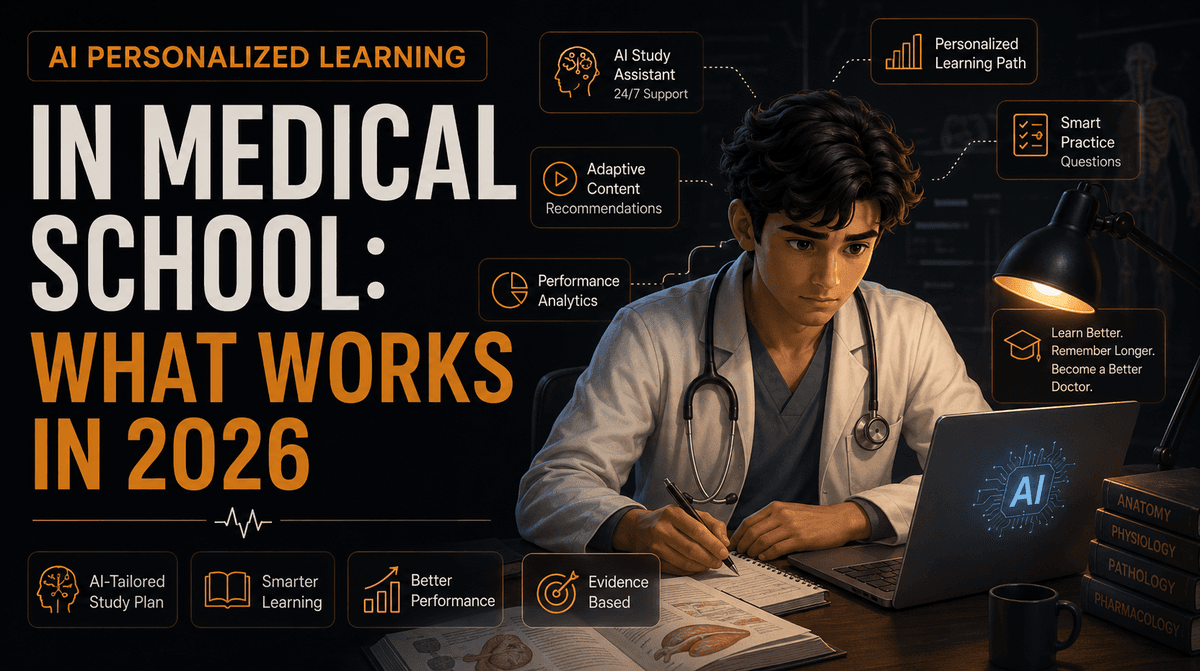
If you're a medical student in 2026, chances are you've already used AI to study. Maybe you asked ChatGPT to explain the renin-angiotensin system for the fifth time. Maybe you generated a batch of Anki cards from a lecture slide deck the night before an exam. Maybe you practiced building a differential with a virtual patient at 1 a.m. because it felt less awkward than asking a resident the same question twice.
Once the novelty wears off, though, a more honest question tends to creep in: is this actually making us better doctors, or just better at sounding like we understand things?
Here's a clear-eyed look from the student side.
The Real Promise We're Seeing
AI has actually delivered on a few things that traditional medical education has struggled with for years.
For one, it adapts to your gaps instead of ignoring them. Rather than sitting through another lecture on a topic you already know cold, some tools can flag where you're weak and push relevant cases or explanations your way. Schools like NYU, Johns Hopkins, and UCSF have built custom AI platforms that generate clinical cases based on an individual student's struggles. Students on these platforms often say they feel more prepared walking into shelf exams and OSCEs, simply because the practice actually targets what they need.
It also offers instant, judgment-free feedback. You can talk through a tough diagnosis out loud, write out a differential, and get a critique back right away, something faculty rarely have the bandwidth to give every student every day. That's been especially valuable during clinical years, when feedback often feels few and far between.
And it cuts down on the busywork. Turning dense lecture notes into flashcards, spinning up practice questions on one specific topic, or getting a plain-language explanation of a complicated pathway now takes minutes instead of hours. Students who use AI with some discipline tend to report spending less time on grunt work and more time actually thinking through cases.
Where the Reality Falls Short
The biggest problem with AI in med school isn't accuracy, though hallucinations still happen more often than anyone would like. The bigger issue is what heavy reliance on it does to how we actually learn.
A lot of students have noticed that leaning too hard on AI starts to dull their ability to reason independently. When a tool can spit out a full differential in seconds, the mental work of building one yourself gets less practice, and that's a muscle, not a fact you can look up later. Educators have started calling this "de-skilling" or "never-skilling," and it's a legitimate concern. Diagnostic reasoning is still a core clinical skill that AI can't fully replace, at least not yet.
There's also a real risk of over-trusting the output. AI can sound completely confident even when it's wrong or missing something important. Students who don't double-check answers against textbooks, guidelines, or an actual faculty member can end up absorbing small errors without realizing it. In medicine, small misunderstandings have a way of compounding into bigger ones.
Then there's the quieter issue: isolation. Personalized AI learning is efficient, sure, but medicine is fundamentally a team sport. Hours spent with an AI tutor are hours not spent hashing out a case with classmates or getting the kind of nuanced human feedback, tone, empathy, clinical judgment, that no algorithm has quite figured out yet.
What Actually Works for Medical Students Right Now
Based on what a lot of us have learned the hard way, the approach that seems to actually hold up looks something like this:
Use AI as a coach, not a crutch. Work through your own reasoning first, then hand it to the AI for critique. Tools that force you to commit to an answer before offering feedback tend to protect your learning far better than ones that just hand you the answer up front.
Verify everything. Treat AI output the way you'd treat a Wikipedia page: fine for getting oriented, never good enough as your final source.
Protect deliberate practice. Keep doing unassisted differentials, handwritten notes, and oral presentations. These are still the reps that build what actually matters on the wards.
Combine AI with the systems that already work. Anki (with some AI help generating cards), UWorld or AMBOSS, and real patient encounters are still the backbone of med school learning. AI works best as a supplement, not a replacement for any of that.
Be intentional about when you reach for it. High-stakes board prep still tends to benefit more from traditional question banks and spaced repetition than from open-ended AI conversations.
The Bigger Picture
AI is speeding up a shift toward precision education in medicine, the idea that training can finally adapt to individual learners instead of forcing everyone through the same rigid track. That's genuinely exciting. Competency-based medical education has been a talking point for years, and AI is finally making pieces of it practical.
But the goal was never just to learn faster. The goal is safer, more thoughtful physicians, and that still requires struggle, reflection, and real human guidance.
The students who end up thriving aren't the ones who use AI the most. They're the ones who use it deliberately, who know when to lean on it, when to push it away, and when to just sit with the discomfort of not knowing something yet.